Templot Club Archive 2007-2020
|
|||
| author | remove search highlighting | ||
|---|---|---|---|
|
posted: 27 Jan 2010 20:52 from: Dellboy
click the date to link to this post click member name to view archived images |
Greetings As a born again railway modeller, of the many things I have been trying to get up to speed on is current thinking on how much one should increase the six foot (track centres) by on double curved track. Hours of Web trawling has drawn a blank. By using simple trigonometry I have managed to determine how to calculate the middle overhang based on track radius and coach bogie centres but how to calculate the end overhang? Should I assume end overhang is at worse equal to middle overhang? Related to this is how much contact allowance should be allowed for, I have assumed 2mm? But is this too small allowing for play in bogie pins etc. I would prefer my six foots to be as close as practicable to the 44.67mm standard. The gauge being modelled is EM, the centre line radius of the outer track is 1,250mm. From my calculation - for a 275mm long coach with 192mm bogie centres middle overhang is 3.69mm. As a comparison - it has been quoted that 50mm centres is ok in OO gauge down to 600mm, assuming this is the inside curve radius, middle overhang calculates out at 7.13mm. Add to this end overhang and there could be a problem??!! Can anyone can help me out on this. Derek |
||
|
posted: 27 Jan 2010 21:28 from: Martin Wynne
click the date to link to this post click member name to view archived images |
Dellboy wrote: By using simple trigonometry I have managed to determine how to calculate the middle overhang based on track radius and coach bogie centres but how to calculate the end overhang? Should I assume end overhang is at worse equal to middle overhang?Hi Derek, Welcome to Templot Club. edit: updated link for Templot2: http://templot.com/companion/index.html?dummy_vehicle_tool.htm regards, Martin. |
||
|
posted: 27 Jan 2010 22:21 from: Dellboy
click the date to link to this post click member name to view archived images |
Martin Wynne wrote: Dellboy wrote:By using simple trigonometry I have managed to determine how to calculate the middle overhang based on track radius and coach bogie centres but how to calculate the end overhang? Should I assume end overhang is at worse equal to middle overhang?Hi Derek, Martin Thanks for that, look forward to the video with interest. Being able to check it on Templot would be particularly useful as the next question for me is to confirm whether I have provided sufficient six foot clearances through a block of reverse curved S&C. Derek |
||
|
posted: 30 Jan 2010 20:25 from: Dellboy
click the date to link to this post click member name to view archived images |
Dellboy wrote:
I have found a Railway Group Standard that reveals normal stock passing clearance should be a minimum of 200mm unless dispensation has been granted for a reduced clearance. This equates to 2.6mm in 4mm scale. |
||
|
posted: 16 Apr 2010 23:17 from: Jamie92208 click the date to link to this post click member name to view archived images |
I've just spent the evening checking clearances on my Lancaster Green Ayre layout where we laid the first length of 6'radius track. I used a 60' coach and found that the end overhang was exactly the same as the centre overhang. In 0 gauge this came to 14mm. I had set my track centre's at an overscale 90mm as opposed to a scale 80mm, on purpose and we found that there was still about 6mm of clearance between two similar vehicles on the bend. The same can be done by printing out a few templates, cutting a piece of plasticard to the shape of a coach and drilling 3mm holes at the bogie centres. You can then use these holes to sight through onto the track centre lines on the printout. Hope this is helpful. Jamie |
||
| Last edited on 16 Apr 2010 23:19 by Jamie92208 |
|||
|
posted: 17 Apr 2010 03:11 from: Martin Wynne
click the date to link to this post click member name to view archived images |
Thanks for jogging my memory Jamie.  I have an unfinished video for Derek. I made the video weeks ago but haven't found time to write up the notes. Sorry about that. Here is the video without the notes. Timbers are shoved to match Derek's dimensions for the bogie centres and overall vehicle length. It is then aligned onto the curved track and snaked past another one to check the clearance. In 4mm scale, I set the vehicle "width" (timber length) to 42mm, i.e. a clearance envelope of 3mm all round the typical vehicle width of 9ft (36mm). So when these "vehicle timbers" are just touching, there is actually still a static 6mm clearance between them. This should be more than adequate to allow for body roll, gauge-slop, off-centre wheels on axles, axle end-play, etc. To maintain the same clearance on curved track as for straight track at 6ft way, it would be necessary to set this dimension to 44.67mm, matching the track centres. edit: updated link for Templot2: http://templot.com/companion/index.html?dummy_vehicle_tool.htm regards, Martin. |
||
|
posted: 21 Apr 2010 22:42 from: Dellboy
click the date to link to this post click member name to view archived images |
Martin Wynne wrote:
Martin Thanks for the video, I have had a quick look at it and think it will serve my needs. I'll have a proper 'play' with it later on, too much happening at the moment to allow me to give it due attention. Derek |
||
|
posted: 3 May 2010 09:10 from: roythebus
click the date to link to this post click member name to view archived images |
Going back to the days when I built the MRC's New Annington layout, we built the oo track with scale 6' spacing with superelevation on the curves. Of course the stock hit each other, when we realised we should have allowed for the underscale gauge! We had to rebuild the curved section to allow for this. I can't remember what track spacing we used, but it was more a case of trial and error in those days. but as others have said, do allow for axle end-slop, bogie pin play etc. |
||
|
posted: 1 Jun 2010 08:52 from: Martin Wynne
click the date to link to this post click member name to view archived images |
The Australian Model Railway Association have published a standard for passing clearance on curves. See: http://www.amra.asn.au/clearance.pdf Here is the relevant section for UK models at 4mm/ft scale (Group 3 in their classification): 2_010343_590000000.png 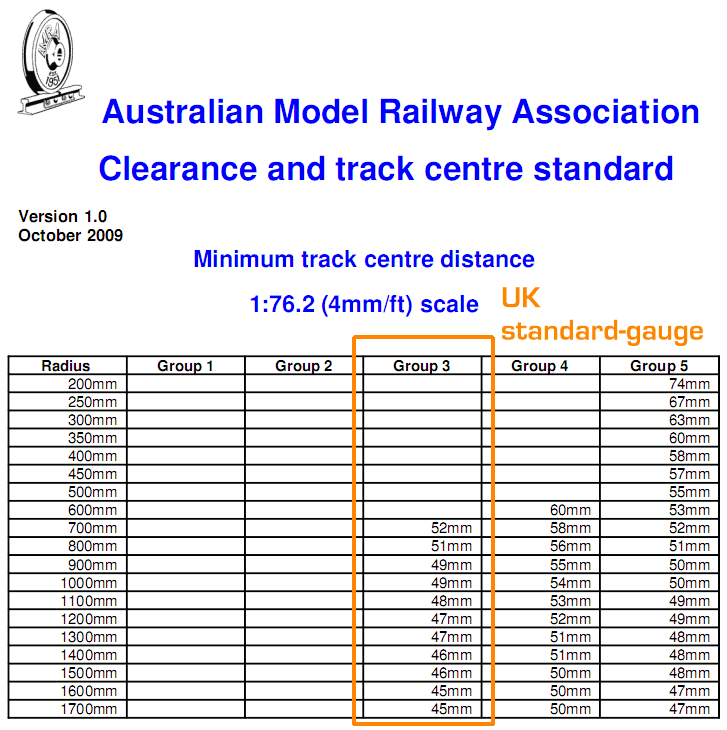 © AMRA Thanks to Terry Flynn for drawing my attention to it. regards, Martin. |
||
|
posted: 1 Jun 2010 12:32 from: Geoff Cook
click the date to link to this post click member name to view archived images |
Which is great till you look on page 10 of the pdf, were it gives 48mm for the minimum clearance for straight track for 1:76.2 4mm/ft group 3 How can we be closer on the curve than we can be on the straight Geoff Cook |
||
| Last edited on 1 Jun 2010 12:35 by Geoff Cook |
|||
|
posted: 7 Jun 2010 11:07 from: Paul Heath click the date to link to this post click member name to view archived images |
From a prototype point of view, body shells are narmally designed to give the same end and centre throws on a 125m radius curve. (I don't know where 125m comes from but it is commonly used). This results in the body end tapers you often see on modern rolling stock as the "corners" are trimmed back to keep the end throw on 125m radius curve the same as the centre throw. 125m is over 2.8m at 1:43.5 so most model railway curves will be tighter than this making end throws very important. You should also be aware that the Group Standard clearance of 200mm is required between the swept envelopes of the vehicles, so it must include the effect of suspension movement, component wear, flange - rail clearance etc. All pretty small effects in model. To be honest though I would rather have a couple of extra mm of clearance than have vehicles striking each other. I hope this is helpfull |
||
|
posted: 10 Jun 2010 10:30 from: dave turner
click the date to link to this post click member name to view archived images |
I find the MOROP standards useful. They can be found at http://www.morop.eu/en/normes/index.html. Dave T |
||
|
posted: 11 Jun 2010 19:06 from: Richard Spratt
click the date to link to this post click member name to view archived images |
The scalefour society recommend the formula I = 8800/R where R is track radius in mm and I is increase in track spacing also in mm. This appear very conservative compared to others above and is based in 57' coaches. |
||


| Please read this important note about copyright: Unless stated otherwise, all the files submitted to this web site are copyright and the property of the respective contributor. You are welcome to use them for your own personal non-commercial purposes, and in your messages on this web site. If you want to publish any of this material elsewhere or use it commercially, you must first obtain the owner's permission to do so. |